
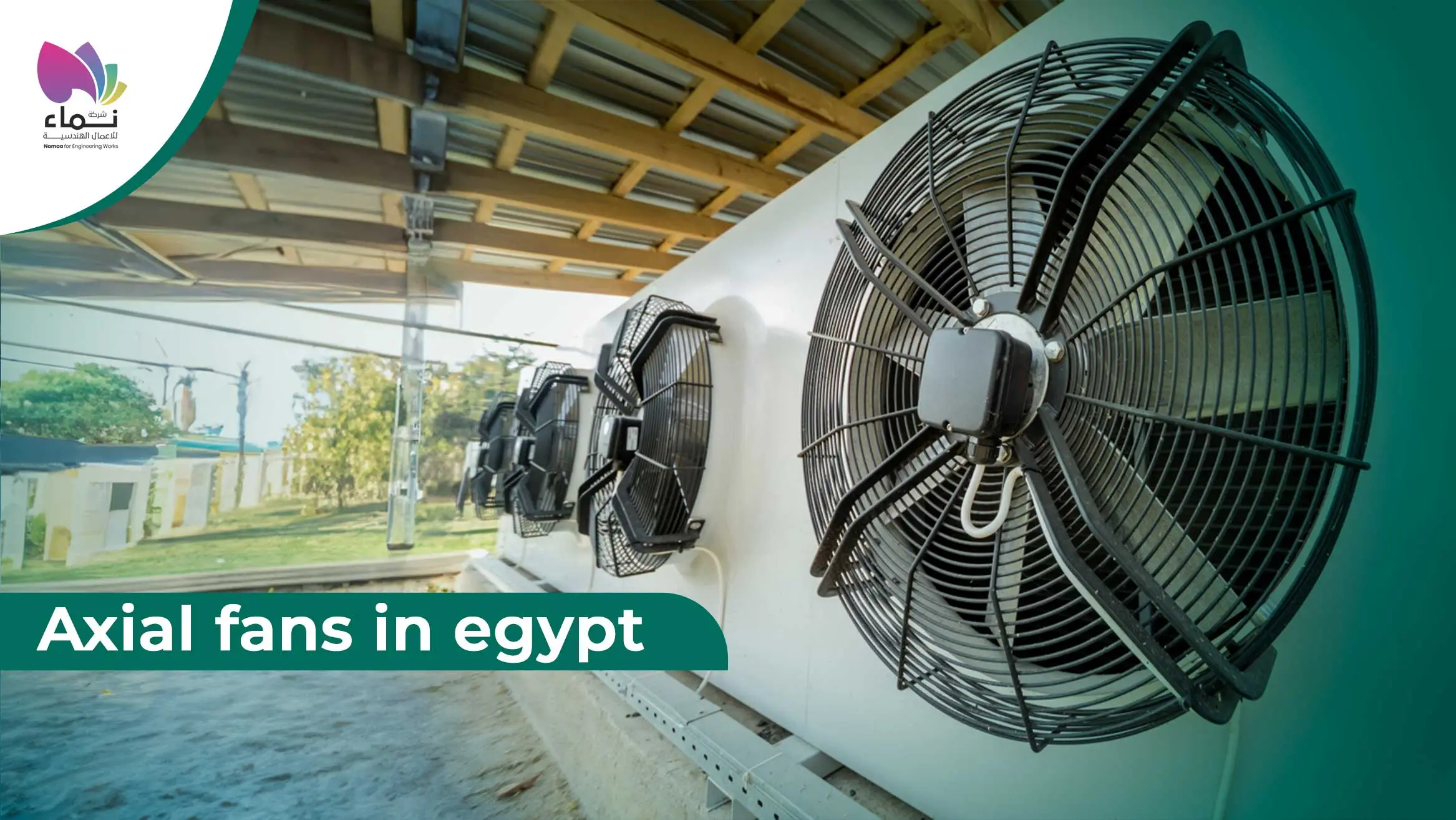
Axial fans in Egypt play an important role in ventilation, cooling, and air circulation systems across industrial, commercial, agricultural, and residential environments. These fans are designed to move air parallel to the shaft around which their blades rotate, making them suitable for applications that require high airflow rates at relatively low pressures.
From ventilating factories and warehouses to cooling industrial equipment and supporting agricultural facilities, axial fans provide practical air movement solutions for a wide range of operating conditions.
Understanding how axial fans work, the available types, and the factors that influence their selection can help businesses choose suitable equipment for their ventilation requirements. This article explains the main applications, technical configurations, selection considerations, and installation practices for axial fans in Egypt.
What Are Axial Fans?
An axial fan is a mechanical device used to move air or gas in a direction parallel to the fan’s rotating shaft. It belongs to the category of fluid machinery and uses rotating blades to create airflow through the fan.
Axial fans are generally known for their ability to move large volumes of air at relatively low static pressures. This makes them suitable for ventilation and cooling applications where air needs to move through an open space or a system with limited resistance.
They are commonly used in heating, ventilation, and air conditioning (HVAC) systems, industrial processes, electronics cooling, automotive cooling systems, and agricultural ventilation.
How Does an Axial Fan Work?
An axial fan operates by rotating its blades around a central shaft. As the blades move, their aerodynamic shape creates a pressure difference that draws air into one side of the fan and pushes it out through the opposite side, parallel to the shaft.
The fan’s airflow and pressure performance depend on several design and operating factors, including blade shape, blade pitch, rotational speed, motor power, and the resistance of the connected ventilation system.
Blade pitch, which refers to the angle of the blades, is one of the factors that influence the fan’s performance curve. However, airflow and pressure cannot be determined by blade angle alone. The actual operating point depends on the complete fan design, rotational speed, and system resistance.
For this reason, engineers should review the manufacturer’s performance curves when selecting a fan. These curves help determine whether a particular model can deliver the required airflow at the expected static pressure.
Main Components of an Axial Fan
An axial fan consists of several essential components that work together to generate and control airflow. Understanding these parts helps identify the factors that affect fan performance, efficiency, and durability.
- Fan Blades: The blades rotate around the central shaft and push air in a direction parallel to the fan axis. Their shape, angle, number, and material directly affect airflow and pressure performance.
- Electric Motor: The motor provides the mechanical power required to rotate the blades. Its capacity, efficiency, and operating speed influence the fan’s overall performance and energy consumption.
- Fan Housing: The housing surrounds or supports the fan assembly, helping guide airflow and protect internal components. Its design also depends on the installation requirements and intended application.
- Central Shaft and Impeller Assembly: The shaft transfers rotational movement from the motor to the impeller, while the impeller assembly carries the blades and supports their rotation.
- Protective Guards: Guards help prevent accidental contact with rotating components and may be installed at the inlet or outlet, depending on the fan design and safety requirements.
The materials and construction of these components should be selected according to the fan’s operating environment, expected workload, and required service life.
Understanding the Need for Axial Fans
Axial fans play an essential role in maintaining proper airflow, controlling temperatures, and improving air quality across residential, commercial, and industrial environments. Their ability to move large volumes of air along the fan axis makes them suitable for various applications, particularly in spaces that require continuous ventilation and efficient air circulation.
1. Ventilation and Air Quality
Axial fans are widely used in ventilation systems to remove stale air, odors, and unwanted airborne particles from enclosed spaces. In industrial facilities, they help extract accumulated heat and support the movement of fresh air throughout the workplace.
Proper ventilation also helps maintain healthier indoor conditions and reduces the buildup of airborne contaminants. The required fan capacity depends on the size of the space, the ventilation rate, and the characteristics of the air being moved.
2. Cooling Systems
Axial fans are important components in different cooling applications, where they move air across heat-generating equipment and surfaces to improve heat dissipation.
They are commonly integrated into cooling towers, heat exchangers, condensers, and industrial cooling equipment. Their airflow capacity helps maintain suitable operating temperatures and prevents excessive heat accumulation.
3. Industrial Processes
Manufacturing plants and industrial facilities use axial fans to support different production and operational processes. These applications include cooling machinery, ventilating production areas, and extracting hot air from equipment and workspaces.
Depending on the process requirements, axial fans can also be installed as part of industrial exhaust and air circulation systems to maintain suitable operating conditions and support the ventilation needs of production areas.
4. Agricultural Ventilation
Axial fans are frequently used in agricultural facilities, including poultry farms, livestock buildings, and greenhouses. They help circulate air, remove excess heat, and control humidity levels within enclosed agricultural spaces.
Proper ventilation is particularly important in poultry and livestock facilities, where continuous air movement supports suitable environmental conditions for animals. In greenhouses, air circulation can also help reduce stagnant air and support temperature management.
5. Automotive Cooling Systems
Axial fans are used in automotive cooling applications to move air through radiators, condensers, and other heat-exchange components. This airflow helps dissipate heat generated by vehicle engines and cooling systems, supporting stable operating temperatures.
Their compact design and ability to deliver substantial airflow make them suitable for applications where effective cooling is required within limited spaces.
6. Energy Efficiency and Sustainability
Energy efficiency is an important consideration when selecting axial fans, particularly in facilities that operate ventilation systems for extended periods.
Choosing a fan with suitable airflow capacity, motor efficiency, and operating speed can help reduce unnecessary electricity consumption. Variable-speed control can also adjust airflow according to actual ventilation requirements, preventing equipment from operating continuously at maximum capacity when it is not needed.
7. Environmental Conditions in Egypt
Egypt’s climate makes ventilation and cooling important considerations for many industrial and commercial facilities. High outdoor temperatures during warmer months can increase cooling requirements, while dust accumulation may affect fan blades, protective guards, and air filters.
In coastal and humid locations, equipment materials and corrosion protection should also be considered. Selecting axial fans according to local environmental conditions helps maintain reliable operation and suitable airflow performance throughout the year.
8. Industrial and Commercial Requirements
Factories, warehouses, workshops, shopping centers, and other commercial facilities have different ventilation requirements depending on their size, occupancy, equipment, and operating activities.
Axial fans can be installed in walls, roofs, or ventilation ducts to provide air circulation and remove excess heat. For larger facilities, the fan capacity and installation configuration should be determined according to the required airflow rate and the resistance of the ventilation system.
9. Domestic Usage and Challenges
Axial fans can also be used in residential applications, particularly for room ventilation, bathroom exhaust, and general air circulation.
Their suitability depends on the required airflow, available installation space, and acceptable noise levels. However, residential installations should consider factors such as electrical safety, proper mounting, noise reduction, and regular cleaning to maintain reliable performance.
Choosing the appropriate axial fan for each application requires evaluating the operating environment, airflow requirements, installation conditions, and expected performance to ensure effective ventilation and long-term reliability.
Types of Axial Fans Available in Egypt

Various axial fan configurations are available to cater to different ventilation, cooling, and air circulation needs across industries and applications. The appropriate configuration depends on the required airflow, pressure, installation arrangement, and operating environment.
The following are common fan categories and configurations used in ventilation and air movement applications:
- Standard Axial Fans: General-purpose fans used for ventilation and air circulation in industrial, commercial, and other spaces.
- High-Volume Low-Speed (HVLS) Fans: Large-diameter fans designed to move substantial volumes of air at relatively low rotational speeds. They are commonly used for air circulation in large spaces such as warehouses and industrial buildings.
- Mixed-Flow Fans: These fans combine characteristics of axial and centrifugal airflow designs. They are a related hybrid fan category rather than a purely axial configuration, and may be considered when the application requires a different balance between airflow and pressure.
- Variable-Pitch Axial Fans: These fans allow the blade pitch to be adjusted in certain designs, providing flexibility to match changing airflow requirements.
- Ducted Axial Fans: Designed for installation within ventilation ducts, these fans move air through a defined duct system.
- High-Temperature Axial Fans: Specially selected and constructed for applications involving elevated air temperatures. Their suitability depends on the temperature rating of the fan, motor, and other components.
- Jet Fans: Also known as tunnel ventilation fans, these are used to move air along enclosed spaces such as tunnels and some parking facilities.
- Marine Axial Fans: Designed for ventilation applications in marine environments, where equipment selection may need to account for humidity, salt exposure, and corrosion protection.
Common Technical Types of Axial Fans
Axial fans are also classified according to their construction and airflow arrangement. Three common technical configurations include:
- Propeller Fans: These fans feature exposed blades and are commonly installed in walls or openings to provide direct air circulation and general ventilation where system resistance is relatively low.
- Tube Axial Fans: These fans contain an axial impeller inside a cylindrical housing, allowing them to be installed within ventilation ducts and provide straight-through airflow.
- Vane Axial Fans: These fans include guide vanes that help straighten the airflow and reduce rotational losses. This design can improve pressure performance and efficiency in applications that require the fan to handle greater system resistance.
Each configuration serves different operating conditions, so the appropriate type should be selected according to the required airflow, static pressure, and installation design.
Axial Fan Motor and Drive Arrangements
The motor and drive arrangement are also important when choosing an axial fan. Two common arrangements include:
- Direct Drive: The impeller is connected directly to the motor shaft. This arrangement has a relatively simple drive system and is used in applications where the selected motor speed matches the required fan performance.
- Belt Drive: Power is transferred from the motor to the fan through belts and pulleys. This arrangement can provide flexibility in adjusting the fan speed through the drive configuration, subject to the manufacturer’s design and operating limits.
The appropriate arrangement depends on the required performance, maintenance considerations, installation space, and manufacturer’s specifications.
Axial Fan vs. Centrifugal Fan: What Is the Difference?
Axial and centrifugal fans are both used in ventilation and industrial air movement systems, but they differ in their airflow direction, pressure capabilities, and suitable applications. Understanding these differences helps engineers choose the right fan for their operating requirements.
Key Differences Between Axial and Centrifugal Fans
- Airflow Direction: Axial fans move air parallel to the rotating shaft, while centrifugal fans draw air through the inlet and discharge it at approximately 90 degrees to the shaft.
- Airflow Capacity: Axial fans are generally suitable for moving large volumes of air in systems with relatively low resistance, whereas centrifugal fans can serve applications requiring higher pressure.
- Installation: Axial fans often feature compact, straight-through designs, making them suitable for wall openings and inline duct installations. Centrifugal fans use a different housing design that directs air through a side outlet.
- Applications: Axial fans are commonly used for general ventilation, cooling, and air circulation in factories and warehouses. Centrifugal fans are often preferred for ducted systems, industrial exhaust, and applications involving higher system resistance.
Which Fan Should You Choose?
An axial fan is generally a suitable option when the priority is moving large volumes of air through a system with relatively low resistance.
However, when the ventilation system requires higher static pressure to overcome duct resistance, filters, or other system components, a centrifugal fan may be more appropriate.
The final choice should depend on the required airflow rate, static pressure, operating environment, and overall system design. You can also review Namaa’s Centrifugal Fan range to compare the available product category with the requirements of your project.
Factors Influencing Axial Fan Selection
Selecting the right axial fan requires evaluating several technical and operational factors to ensure that the equipment meets the ventilation requirements of the intended application. Engineers and facility managers should consider the following ten factors before choosing an axial fan.
1. Airflow Requirements
Airflow capacity is one of the most important factors when selecting an axial fan. It refers to the volume of air that the fan can move within a specific period and is commonly measured in cubic meters per hour (m³/h) or cubic feet per minute (CFM).
The required airflow depends on several considerations, including the size of the facility, the number of air changes needed, the amount of heat generated by equipment, and the nature of the application.
Selecting a fan with insufficient airflow may result in inadequate ventilation, while unnecessarily high airflow capacity can increase energy consumption and operating costs.
2. Space Constraints and Installation Considerations
The available installation space determines where and how an axial fan can be mounted. Before selecting a fan, it is important to evaluate the installation location, surrounding structures, airflow clearance, and accessibility for future maintenance.
Axial fans can be installed in different configurations, including wall-mounted, roof-mounted, and duct-mounted arrangements. The selected configuration should allow unobstructed air movement while providing sufficient clearance around the inlet and outlet to avoid unnecessary airflow restrictions.
The installation location should also allow technicians to access the fan safely when inspection or maintenance is required.
3. Environmental Factors and Regulations
Environmental and regulatory requirements should be evaluated before installing an axial fan, particularly in industrial and commercial facilities. The selected equipment should comply with the applicable electrical safety, fire protection, workplace safety, and project-specific ventilation requirements.
Depending on the application, additional considerations may include motor protection ratings, insulation requirements, material specifications, and relevant industry standards.
These requirements help ensure that the fan is suitable for its intended use and complies with the applicable project regulations. Specific compliance requirements should be confirmed with the project engineer and equipment manufacturer.
4. Static Pressure
Static pressure refers to the pressure the fan must generate to overcome resistance within the ventilation system. This resistance may come from air ducts, filters, grilles, bends, dampers, and other system components.
Axial fans are generally suitable for applications requiring high airflow at relatively low pressure. However, selecting a fan without considering the system’s total resistance can lead to lower-than-expected airflow and inefficient operation.
Therefore, engineers should evaluate both the required airflow rate and static pressure when reviewing fan performance curves and selecting the appropriate model.
5. Operating Environment
The actual operating environment has a direct impact on axial fan performance, reliability, and service life. Important conditions to evaluate include ambient temperature, humidity, dust concentration, exposure to chemicals, and the characteristics of the air being moved.
For example, facilities handling dusty air may require suitable blade materials and protective arrangements, while humid or corrosive environments may require corrosion-resistant construction.
High-temperature applications also require fans and motors specifically rated for the expected operating conditions.
6. Size and Space Constraints
The physical dimensions of an axial fan must match the available installation opening and the design requirements of the ventilation system. Important specifications include fan diameter, housing dimensions, mounting plate size, duct diameter, and overall equipment depth.
Choosing an incorrectly sized fan may create installation difficulties, restrict airflow, or prevent the equipment from achieving its required performance.
It is therefore important to compare the manufacturer’s dimensional drawings and technical specifications with the actual installation requirements before purchasing.
7. Noise Levels
Noise is an important consideration when selecting axial fans for factories, commercial buildings, offices, and residential facilities. Excessive fan noise may affect workplace comfort and create disturbances in noise-sensitive environments.
Noise levels are generally measured in decibels (dB or dB(A)). They can be influenced by fan speed, blade design, airflow conditions, installation quality, and system resistance.
Selecting a fan that operates efficiently at its required performance point, together with proper mounting and vibration isolation, can help minimize unwanted noise.
8. Energy Efficiency
Energy efficiency directly affects the long-term operating costs of ventilation systems, particularly in facilities where fans run continuously or for extended periods.
Selecting an efficient motor and a fan that operates close to its intended performance point can help reduce electricity consumption.
It is also important to consider the relationship between airflow capacity, static pressure, motor power, and overall fan efficiency. Oversized equipment may consume more energy than necessary, while variable-speed systems can adjust fan operation according to changing ventilation requirements.
9. Control Options
Control options determine how the axial fan operates under different working conditions. Depending on the selected motor and fan configuration, available options may include manual switching, speed controllers, variable-frequency drives (VFDs), and automated control systems.
Variable-speed control can be particularly useful in industrial and commercial facilities where ventilation requirements change throughout the day. Adjusting the fan speed according to actual demand can improve operational flexibility and help reduce unnecessary energy consumption.
However, the selected control method must be compatible with the fan motor and its manufacturer’s specifications.
10. Maintenance Requirements
Maintenance requirements should be considered before purchasing an axial fan to ensure convenient inspection and long-term operation.
Regular maintenance typically includes cleaning fan blades and protective guards, inspecting motor connections, checking mounting points, and monitoring unusual noise or vibration.
The frequency of maintenance depends on operating hours, environmental conditions, and the amount of dust or contaminants present in the airflow. Selecting a fan with accessible components and suitable construction can simplify maintenance procedures and reduce unexpected downtime.
By evaluating all ten factors together, businesses can select axial fans that meet their ventilation requirements while maintaining reliable performance, energy efficiency, and long-term operational value.
How to Choose the Right Axial Fan for Your Needs
Selecting the right axial fan involves more than comparing product sizes or motor power. The fan must match the airflow and pressure requirements of the complete ventilation system.
The following steps can help engineers and facility managers evaluate suitable options:
1. Determine the Required Airflow
Start by identifying the volume of air that needs to be moved. This may depend on the room or facility dimensions, required air changes, heat generated by machinery, and the ventilation purpose.
The required airflow should be established before comparing fan models.
2. Calculate the System Static Pressure
Identify the resistance created by ducts, filters, grilles, bends, dampers, and other components in the system.
The selected fan should be capable of delivering the required airflow at the calculated system pressure, rather than relying only on its maximum airflow rating.
3. Evaluate Installation Conditions
Check the available installation opening, fan diameter, mounting arrangement, inlet and outlet clearance, and access for future inspection.
Also consider whether the fan will be wall-mounted, roof-mounted, or installed within a duct.
4. Check Motor and Power Requirements
Review the motor power, voltage, operating speed, efficiency, and compatibility with the available electrical supply.
If speed control is required, confirm that the motor and fan configuration support the selected control method.
5. Compare Fan Performance Curves
Review the manufacturer’s fan performance curves to confirm that the selected model can provide the required airflow at the expected static pressure.
It is also important to consider operating noise, energy consumption, and the conditions under which the fan will run.
Namaa Company can help customers evaluate suitable fan options according to their application and project requirements. The Axial Fan Direct Drive product is one of the available product references to consider when reviewing axial fan solutions.
Axial Fan Installation and Maintenance Tips
Proper installation and regular maintenance are essential for maintaining axial fan performance, preventing unexpected breakdowns, and extending equipment service life.
Installation Considerations
- Correct Positioning: Install the fan in a suitable location that allows unobstructed airflow and supports the intended ventilation direction.
- Secure Mounting: Ensure that the fan is firmly mounted to reduce unwanted movement and vibration during operation.
- Electrical Connections: Verify that the electrical supply and motor connections comply with the manufacturer’s specifications.
- Airflow Clearance: Provide sufficient clearance around the fan inlet and outlet to avoid unnecessary airflow restrictions.
- Safety Guards: Ensure that protective guards and other safety components are installed as required by the equipment design and applicable safety requirements.
- System Compatibility: Confirm that the fan is suitable for the connected ductwork or ventilation arrangement and that the installation does not create unexpected resistance.
Routine Maintenance
- Blade Cleaning: Remove accumulated dust and debris from the blades and housing to maintain efficient airflow.
- Motor Inspection: Check the motor for unusual noise, overheating, and signs of wear.
- Vibration Checks: Inspect mounting points and rotating components for excessive vibration.
- Electrical Inspection: Check wiring and electrical connections for signs of damage or deterioration.
- Protective Component Inspection: Check guards and other protective components to ensure that they remain securely installed.
- Performance Monitoring: Monitor airflow and operating conditions to identify changes that may indicate a blockage, damage, or another performance issue.
Always disconnect the electrical power before performing inspection or maintenance work, and follow the manufacturer’s maintenance recommendations. Maintenance should be carried out by qualified personnel whenever electrical or mechanical work is required.
Axial Fan Suppliers and Manufacturers in Egypt
The market for axial fans in Egypt serves a wide range of industrial, commercial, and residential ventilation and cooling requirements. When comparing suppliers and manufacturers, businesses should evaluate more than the initial equipment price.
Important considerations include product specifications, construction quality, motor efficiency, technical documentation, availability of suitable configurations, and after-sales support.
Namaa Company: Axial Fan Solutions
Namaa Company provides ventilation solutions for industrial, commercial, and residential applications. Its axial fan offerings can be considered for projects that require air circulation, ventilation, and cooling.
When choosing an axial fan supplier, customers should consider the following points:
- High Performance: The selected fan should meet the required airflow and static pressure conditions for the intended application.
- Durable Construction: Fan materials and components should be suitable for the operating environment and expected service conditions.
- Energy Efficiency: Motor efficiency and fan operating performance should be considered to help manage long-term electricity consumption.
- Customization Options: Where available, fan configurations and specifications should be evaluated according to the project’s size, airflow capacity, and operating requirements.
- Reliable Support: Technical assistance and access to product information can help customers select, install, and maintain suitable equipment.
International brands operating in Egypt may also be considered when comparing available fan solutions. The most appropriate supplier is the one that can provide equipment specifications and technical support that match the project’s actual requirements.
Businesses looking for axial fans in Egypt can contact Namaa Company to discuss their ventilation needs and identify suitable product options.
Industrial Air Blowers for Sale in Egypt
Industrial air blowers are used in a range of applications that require air movement, ventilation, cooling, or process-related airflow. Businesses searching for industrial air blowers for sale in Egypt may find different equipment configurations designed for specific industrial requirements.
Although axial fans and industrial air blowers both move air, they should not be treated as identical equipment. Axial fans move air mainly parallel to the fan shaft, while the term industrial air blower can refer to different equipment designs, including centrifugal and other blower configurations.
The appropriate solution depends on the required airflow, operating pressure, system resistance, and intended application.
For example, axial fans may be suitable for general ventilation and air circulation where high airflow is required at relatively low pressure. Other blower configurations may be more appropriate for applications that require higher pressure or a different airflow arrangement.
Before purchasing industrial air blowers or axial fans, businesses should compare the technical specifications and confirm that the selected equipment matches the requirements of the complete system.
Conclusion
Axial fans in Egypt support ventilation, cooling, and air circulation across a wide range of industrial, commercial, agricultural, and residential applications. Their ability to move large volumes of air along the fan axis makes them suitable for systems that require effective airflow at relatively low pressure.
Choosing the right axial fan requires evaluating airflow capacity, static pressure, installation conditions, operating environment, noise levels, energy efficiency, control options, and maintenance requirements.
Understanding the available fan configurations and comparing their performance specifications can help businesses select equipment that meets their operational needs. Namaa Company provides ventilation solutions and can assist customers in considering suitable axial fan options for their projects.
FAQs
Yes, Namaa Company offers axial fans specifically designed for residential applications, providing efficient cooling and ventilation solutions for homes.
It's recommended to conduct regular inspections and maintenance checks on axial fans at least once every few months to ensure optimal performance and longevity.
Yes, Namaa Company offers customization options to tailor axial fan solutions to specific requirements, including size, airflow capacity, and additional features.